- Zen Online
- Posts
- The Open Secret
The Open Secret
Truth is not hidden, but until you verify it for yourself, it is not apparent. Issue #18 (April 2026)

Madoka Onizuka
April 01, 2026
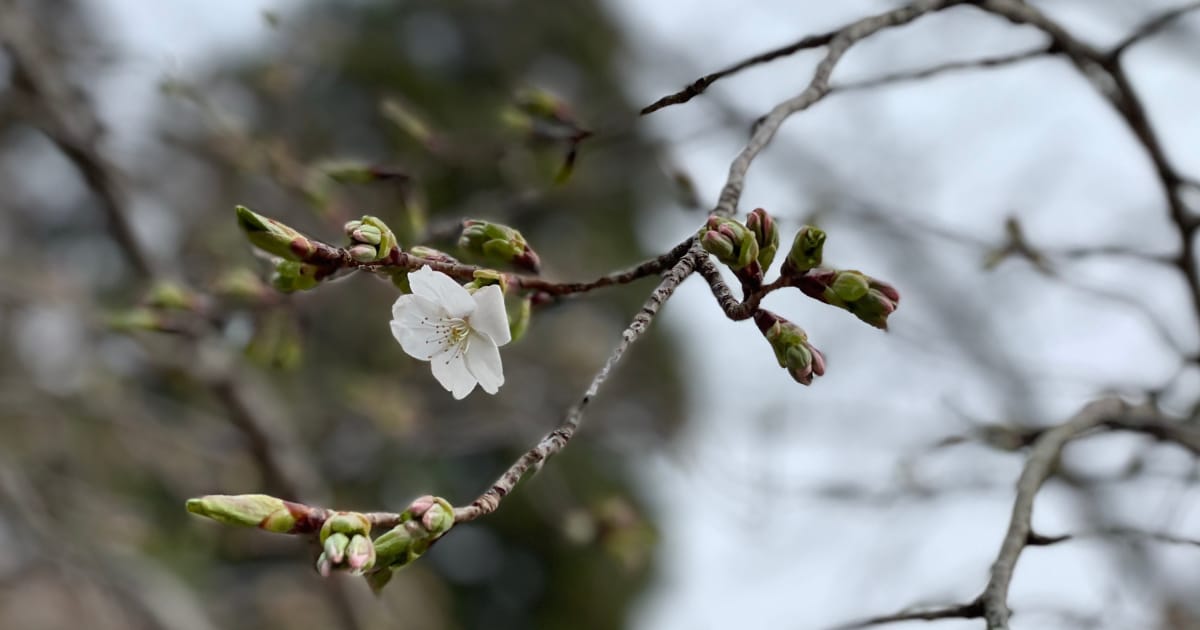
Table of Contents
To Our Dear Sangha
Cherry blossom season has begun. The air feels warmer and there are hints of pink here and there. Soon it will be pink everywhere.
In this month’s newsletter, Today’s Teisho is about “the open secret” that is Truth. How can Truth be so out in the open but feel so illusive? I’ve wondered about this myself, but as the teisho makes clear, it is more beneficial to do zazen than to ponder.
I will be introducing a booklet that is the English translation a teisho by Inoue Kando Roshi, Matsumoto-san’s teacher.
There are a couple more announcements in addition to the usual schedule, so please do take a look below before heading to the teisho.
Announcements
Webpage with our Lineage
We are immensely grateful for our teachers. For information on the lineage of Zen Online, please see the bios of Inoue Gien Roshi and Inoue Kando Roshi on the Lineage Page on our website.
Upcoming Online Zazenkai Schedule (Japan time):
Zazenkai with Matsumoto-san:
April 5 (Sun) 19:00-23:00
April 20 (Mon) 8:00 a.m.-12:00 noon
May 17 (Sun) 19:00-23:00
May 25 (Mon) 8:00am-12:00 noon
**Weekend times are generally more convenient for Europe, Africa, and Asia. Monday times are generally more convenient for N/S America and Oceania.
Zazenkai with Madoka:
Zazenkai with Madoka are simply opportunities to do zazen for an hour. I provide instructions to newcomers if necessary. And yes, newcomers are always welcome!
- Ongoing: Thursday Zazenkai with Madoka will continue every week at 9:00pm-10:00pm Japan time.
- New Online Zazenkai: Monday mornings, 9:00am-10:00am (Sunday afternoon/evening in North and South America). April 1-hour Mondays will be the 6th, 13th, and 27th. The 20th is zazenkai with Matsumoto-san.
- New In-Person Zazenkai: From April 18, Madoka will begin monthly in-person zazenkai in Nishinomiya, Hyogo Prefecture for both Japanese and English speakers. Please come if you are ever in the area! Information is here (new site).
Zazenkai reservations can be made here:
https://www.zen-online.info/reservations
Very Useful Time Converter to calculate zazenkai in your local time
https://www.timeanddate.com/worldclock/converter.html

”Teishō” is when a Zen master shows/conveys Truth to gathered students or disciples.)
(Translated by Madoka)
The Open Secret (Truth is not hidden, but until you verify it for yourself, it is not apparent)
Facing forward, there is what appears, just as it is.
What appears itself is Truth. When there is meow, the meow itself is Truth. When drinking tea, the taste of the tea itself is Truth. But it probably doesn’t feel like Truth to you.
Face forward, and what appears itself is immediately there, as it is. In this way, Truth is not hidden. It is completely in the open.
It is in the open, but it is such a matter of course that most people do not even take note of it. Many people, when trying to know Truth, use thinking to do so. I was like that too.
But no matter how much you learn, contemplate, or build on understanding, it is impossible to be convinced that what appears itself is Truth. The reason is that the moment you try to know what appears, it is no longer what appears itself. In addition, understanding is created by thinking.
What appears as a matter of course, is itself Truth. This becomes clear through correct zazen and awakening for yourself.
Zazen is not difficult. People think it is difficult when they misunderstand and think they must create and maintain some kind of state.
What actually appears is what actually appears, so it is not difficult, and it is not easy. It is always just as it is, so there is no room for “I can” or “I can’t.”
It is already just as seeing, hearing, sensing, and knowing are. So there is no method to Truth. From this, I think you can understand that zazen is sitting just as seeing, hearing, sensing, and knowing are.
When I was practicing, I would sit for longer periods of about 2 hours after work and on my days off. In addition, whenever I found a chance to sit, I would sit right then and there. My posture was whatever suited the occasion. For example, if I finished one task at work, I would sit in the chair at my desk for a few minutes. Whether I was on the train, waiting for something, or taking a bath, I did zazen regardless of time or place.
Looking back at my zazen practice, I see the importance of sitting for long periods, but I think sitting then and there, whenever I found a chance, was very effective for satori.
Satori—knowing what you truly are—is possible for anyone. How about giving zazen a try? We look forward to sitting with you.

Inoue Kando Roshi’s Teisho Translated into English
In 2016, I attended my first sesshin with Inoue Kando Roshi, an enlightened Zen Master and Soto Zen monk. He is also Matsumoto-san’s teacher. The sesshin (5-day Zen retreat) was at a temple called Tozanji in Niigata Prefecture.
At that time, I was still trying to do zazen. I struggled with thinking too much and imagining what satori might be like, trying to get closer to how I thought an enlightened person would be. I asked many questions about Truth, believing that deepening my understanding would help me awaken to it.
Then, Kando Roshi gave his first teisho, explaining that in order to have a real Zen practice, it was necessary to know the basic premise that Dogen Zenji laid out at the beginning of one of his texts, Fukanzazengi. (Dogen Zenji founded the Soto school of Zen in the 13th century.)
I remember listening and feeling both astounded and confused. My dear friend Rena was also attending, and during a break, she mentioned how incredible the teisho was. I agreed, but also said I didn’t understand it. She looked a little concerned and said maybe someday she could translate it into English so that I could really get it. But I had to honestly say it wasn’t just a language issue. I felt like I was hearing something that, while I could understand most of the words, I was missing something very important.
Looking back, what I was missing was the essential premise that Dogen Zenji and Kando Roshi were both pointing out.
Kando Roshi would hold up a hand-held fan, unfold it, and then fold it. He was showing us the essential premise.
The essential premise was unfolding before my very eyes (pun unintended). Just like that. But I tried to figure it out. What was he doing by folding and unfolding the fan? What was he trying to show us? I pondered these questions as if there was something other than the folding and unfolding that I was supposed to see.
Kando Roshi also explained how people get confused or lost in delusion. I had no difficulty understanding that! But I felt lost during the simple acts showing us exactly what Truth is because I tried to understand them. I thought there had to be something more to it.
That teisho played an important part in my realizing that I was missing something by trying to understand. I am grateful for having been there, and am happy to announce that an English translation of the teisho is now available. My friend Rena followed through on her dream to give English speakers access to this teisho. She not only attended it live, she transcribed it and worked together with Kando Roshi to edit and translate it into English.
The Fundamental Premise of Zen Practice, by Inoue Kando Roshi, edited and translated by Rena Sugita. If you are interested, more information is available here: https://inouekandoroshi.wixsite.com/english
Please share our newsletter with anyone you think would be interested.
https://zen-online.beehiiv.com/subscribe
It is also possible to see past issues and to unsubscribe at any time.
Love and Gassho _/\_
the open secret